Thursday, February 11, 2016

More Cumberland House - 1915

My father had some memories of living at Cumberland House:


"My two aunts did get up by canoe a few times and in the spring a small paddle-wheel steamer made it up the Saskatchewan while the river was full. The mosquitoes and “no see-ums” were very bad. We lived off moose, fish, canned vegetables and whatever native berries were there. The lake had sturgeon in it and a Russian used to make caviar for my folks. I have a few memories of the North but very little. I can remember a few Cree phrases. Tom and I wore moccasins and deer or moose (hide) coats. It was a swampy country and extremely cold in the winter. Revillon did their best to keep us up there but Mother did not want to stay. We all returned to Prince Albert and then to Winnipeg."

 Thomas Knevitt Pinhey and Edward Shellard Pinhey at Cumberland House

 Daisy, Edward and Thomas Shellard Pinhey at Cumberland House

 Thomas Knevitt Pinhey in winter wear

 Getting the dog sled ready


 Daisy, Thomas and baby Edward


 Ready to get under way...


Cumberland House, 1915

Cumberland House flood, 1915 


 Boating, Cumberland House, 1915

 Edward (Ted) Shellard Pinhey, 1915

 Tommy, Ted and Agnes, Cumberland House, 1915

Tommy, Ted and Mrs. Sayce, Cumberland House, 1915

Wednesday, February 10, 2016

The Stillwell's Sons

My father's memoirs state that he had two cousins, Eric and John, who were the sons of Fanny Sarah and Clarence Stillwell.  My father describes Clarence Stillwell's business (  they were "gold lacemen, embroiderers & general military wear, specialities: gold lace, embroidery, Masonic clothing & jewellery").  He goes on to note that both Eric and John were killed serving in World War II.  The Stillwell's are described in their school honor roll as follows (Dulwich College):


MAJOR ERIC WILLIAM DIGBY STILLWELL 
117th Bn. The Queen's Royal Regiment.

Born May 24, 1911. He was the elder brother of J. D. Stillwell and on leaving school he spent about a year with Jaeger Ltd., and another with a firm of chartered accountants, to gain business experience and in 1930 he joined the family business of Edward Stillwell & Son, Ltd., of Barbican, E.C., eventually becoming a director.

He was the fifth successive generation in the family business. He was a liveryman (by servitude) of the Worshipful Company of Gold and Silver Wyre Drawers, with which his family had also been closely connected. In the Certificate" A " examination at School he was a Kittermaster prize winner and as soon as he was eighteen was commissioned to the 24th Battalion London Regiment, which later became the 7th (Southwark) Battalion The Queen's Royal Regiment. On mobilization he was captain, commanding" B " Company which he took to France in 1940. They did useful work in the retirement from Brussels and returned via Dunkirk. He was promoted major in I941 and proceeded in July 1942 with the 44th Division to the Middle East in command of the H.Q. Company. Shortly after arrival he became second-in-command and a few weeks before his death, in the absence of the C.O., he commanded the battalion in action. He fell in the opening stages of El Alamein, on October 24, 1942, along with the majority of the officers of his battalion, when the Infantry attacked the minefields in advance of the armour. He married, in 1940, Dorothy Joan, daughter of Edgar Millar, of Forest Hill and left no family.

LIEUTENANT JOHN DIGBY STILLWELL 
44th Bn. Royal Tank Regiment.

Born August 30, 1914. He was the younger brother of E. W. D. Stillwell and on
leaving Dulwich College went to Pawson & Leafs, Ltd., textile warehousemen, St. Paul's
Churchyard, for about eighteen months to gain general experience. He then joined Constable, Hart & Co., road works and general contractors, for a short time before going to George Wimpey & Co., Ltd., with whom he was engaged on various construction undertakings such as water-works, new aerodromes, etc., up to the outbreak of war.

He joined the O.A.F.C. on leaving School and the Westminster Dragoons about a year later, being a lance-corporal; he became a cadet in the same regiment on the outbreak of war, obtaining his commission in January 1940 in the Royal Tank Regiment, and being posted to the 44th Battalion (formerly the 6th Gloucesters T.A.).  He proceeded to the Middle East with them in May 1941 and took part in Auchinleck's Libya campaign and led the New Zealand Division to the relief of Tobruk, breaking through in a tank attack by night. He was wounded at El Duda and was evacuated from Tobruk, but H.M.S. Chakdina, in which he sailed, was sunk by enemy action and he is now presumed to have been lost at sea on December 5, 1941. He was the battalion signals officer and as such came in contact with all the squadrons of the regiment by whom he was much missed. He married, in March 1939, Janet, the youngest sister of J. D. East (O.A.), and had one son, born on the day that his father was reported missing.


Sunday, September 27, 2015

A Poem and Some Detective Work

This post is out of sequence chronologically as it refers to events and photos from 1911-12 (prior to Thomas and Daisy moving to Cumberland House with Tommy).  As I was going through papers and photos, I found the following poem written by Thomas K. Pinhey in 1912:


To a Ten Dollar Bed Lounge
By
T. Knevitt Pinhey

1
Peace is here and ceased is strife
Happiness for child and wife
Husband too at Eighteenth Street
And they find it very sweet
For their Iris, dear, has flown
Left their happy little home
On the bed does Knevitt lie,
No more thro the night he’ll sigh
On that bony, creaking lounge,
On that hard, unyielding lounge.
2
In the morning he can clean
From his toes clear to his bean
He can slide into his bed
Covering up his greasy head
He can feel sure the clothes
Will be covering up his toes
When the cold dawn he shrinks
Loud he laughs as he oft thinks
Of that bony, creaking lounge.
3
Iris to P.A. will run
When with us we have the sun
On the porch then she shall sleep
The mosquitoes safe to keep;
She shall have a hammock wide
Lined with cotton wool inside,
But we’ll never ask her more
All night thro to twist and snore
On that bony creaking lounge
On that hard unyielding lounge.

Thomas' poem refers to "Eighteenth Street" and, with a little digging, I was able to find a 1911 photo of a house labeled "338 18th Street W" Prince Albert and photos labeled 1911 showing Thomas, Daisy and Tommy at the same house.  Also, I found a photo of Iris and what I suspect is the "Ten Dollar Bed Lounge" referred to in T.K.'s poem.  The house at 338 18th Street West shows up in the prior post about Waitville and I have corrected the captions accordingly.  Here are the photos - the poor quality of these photos and the photos of Cumberland House are due to the photos being developed at home by T.K. (and at the trading post):


Iris and the $10 Bed Lounge (this photo was labeled as "Iris")
Iris in a later photo (must be Winnipeg! It's cold!)

 Thomas Knevitt Pinhey at 338 18th Street W (1911)

Thomas and Daisy at 338 18th W (1911 - might be the earliest photo of Thomas and Daisy as a couple)

Thomas at Work - Thomas is in the center holding a hat - the man on the left is Elliot Fisher and the other man is W. Ireland (?) 


338 18th Street W (Daisy is in this photo)


Saturday, September 12, 2015

Cumberland House


The Revillon Freres Trading Post, Cumberland House 1914


My father's memoirs recall how Thomas and Daisy moved to Cumberland House around 1913:

"My parents (Thomas Knevitt Pinhey and Daisy) moved to Prince Albert, Saskatchewan and my father made a living at various jobs. He worked part-time as a stagehand, sold flour for a milling company and did some accounting for Revillon Freres (Revillon Brothers), a French fur trading and luxury goods company whose headquarters were in Paris and also New York. They were in competition with the Hudson Bay Company. Revillon Freres sent him to Cumberland House, their central post, to audit and manage while the “factor” was on vacation (a factor, from Latin for ‘doer or maker’ is a mercantile fiduciary who receives and sells goods on commission). I forgot to mention that my brother, Thomas Shellard Pinhey was born in Prince Albert in November 1911.

Apparently my father’s audit revealed the fact that something was wrong in the management of the Revillon post at Cumberland House and he was offered the job as factor of the post. This involved trading with the Cree Indians, primarily for muskrat pelts. Flour, tea, tobacco, clothing and other necessities were traded for the furs. Father did well and after the first two years contract; he signed up for another two years.
     
I, Edward Shellard Pinhey, was born Sept 10, 1914 at Cumberland House. The main building was not complete and I was born in a sort of log cabin.  My parents had canoes posted down the river (Saskatchewan) to create relays to get mother to Le Pas, the closest place where a doctor was available, but I arrived early and the canoe men had a nice holiday while my mother was availing herself of the services of “old Nokom” the one midwife. Nokom was not a painless practitioner, but with my father as an assistant, brought “Little Musquasis” (little bear) into this world. I earned the name Musquasis by grunting a lot. A six ounce lead fishing weight was placed on my navel while mother was being attended to and I can thank my father and Nokom (grandmother) for my “shapely” navel. The relays of canoe men were recalled and all went well."

A note of interest - when Thomas K. Pinhey worked as a stagehand, he saw Charlie Chaplin perform as a member of the Karno comedy troupe in Canada around 1911.  My grandfather was not impressed with Charlie because, as he said, Charlie's idea of comedy was to eat soda crackers and then spray them out of his mouth (spit take?) onto another of the actors as part of a comedy routine.  T.K. considered this to be a bit uncouth.  Charlie, of course, went on to be a mega-star in silent films.


Canoe on the River near Cumberland House, 1914

The log house where Edward Shellard Pinhey was born (photo dated 1914)

Daisy Pinhey and  Edward S. Pinhey ("Musquasis" is 1 month old)

Sarah (helping Daisy), Daisy Pinhey and Edward 1914

Monday, August 24, 2015

Noel Knevitt - Mystery Relative?


More often than not, one runs across photos of relatives and friends that cannot be identified because the memory of them is lost to time.  Here are three interesting photos that were captioned as photos of "Noel Knevitt".  The photos are interesting and provide some clues to the man, however, I cannot turn up any documentation of a Noel Knevitt in the available record.  Noel may be a nick-name or his middle name. I assume he is a relative of Fanny Maude's family.  Perhaps somebody out there may have some information


 Thomas Knevitt Pinhey and Noel Knevitt, 1909
This photo was captioned and dated. It was obviously taken in Canada due to the date.  Noel appears to be quite tall next to Thomas.

 Noel Knevitt in India
This photo was in a grouping of photos in the 1912-1913 period.  It was captioned as "Noel in India" and it appears that he was in the British Army during this period.  I will need to check the army rosters to see if I can locate a Knevitt serving in India during this time period.

Noel in Canada
This photo was in the same grouping as the India photo.  It appears to be the Canadian frontier, but there is not enough detail to tell precisely where.  I will post any additional photos of Noel to this page if identity more while going through the albums. 

Sunday, August 23, 2015

Staying in Canada - Thomas Knevitt Pinhey and Daisy Laura Shellard

Winnipeg 1910
This may be the first photo of Thomas Knevitt Pinhey and Daisy Laura Shellard together.  Thomas is on the lower right, sitting on the step (wearing a fedora hat).  Daisy is on the left side sitting next to the planter (above the woman in black). The photo is labeled 
"Winnipeg, 1910".

William Fox and Fanny Maude's return to England closes the chapter on their lives.  My grandfather, Thomas Knevitt Pinhey stayed on in Canada with his brothers.  Thomas and Daisy had a very interesting life in Canada and Thomas was quite the amateur photographer. Consequently, there are many photos of Thomas and Daisy and their family in Canada, which will help frame the next posts along with my father's writings about his life.  The following narrative about Thomas and Daisy comes from my father's memoirs written around 2006-2007:

"My family background is definitely English. My paternal grandparents were William Fox Pinhey and Fanny Knevitt Pinhey. His occupation was listed as “gentleman” and she was his wife. My great grandfather was William Green Pinhey and I am not aware of my great grandmother’s maiden name. My Mother was born in Bristol. Her maiden name was Daisy Shellard; her mother was Laura Longman. The name McCauley seems prominent in my mother’s family. Knevitt is fairly prominent in English history as Lord and Lady Thomas & Elizabeth Knyvitt: Baron & Baroness of Escrick. The Pinheys may have been Welsh & the Shellards are one of those Flemish families that were brought to England to teach the art of weaving to the wool producing Britons. (note: William Fox Pinhey's family was originally from Brixham, Devon. So it is doubtful that the name is Welsh as Pinhey's can be found in Devon throughout its history. My father did not have access to this information).

I had an Uncle Will Pinhey, Robert Pinhey, Aunt “Faff” Pinhey and Aunt Madge Pinhey, who died young. My father Thomas Knevitt Pinhey was the youngest of the group. I am less well informed as to my maternal branch but will do my best. My grandfather, Arthur Shellard was married to Laura Shellard. Then ensued my mother, Daisy Laura Shellard, Edward McCauley Shellard, John Shellard, Hilda Shellard, Iris Shellard and Tom Shellard, some of whom were born in Bristol, England (my Mother for one) & the younger in Winnepeg, Manitoba, Canada.

My paternal grandparents were from monied people, but along with many English people came on hard times as did my maternal grandparents. About 1906-07 they migrated to Canada. My Uncle Bob was sent to an “ag” school for a few months before leaving England. My father and uncle Bob both attended St. Dunstans in Catford. This was an upper class school. I visited it in 1987 and was quite impressed.

Grandfather Pinhey took out a full section (640 acres) homestead at Birch Hills (Waitville), Saskatchewan. This was 160 acres for each son and the father. Grandpa Pinhey had never worked nor had my grandma. Going to the Canadian wilderness, with no servants must have been a real jolt. They built a farmhouse, broke land and planted wheat, raised poultry, beef, hogs etc. Plowing was done by oxen.

My father had enough of this after about one year and he left for Winnepeg where he got a clerical job with the C.P.R. Railway. He lived in a boarding house with several “remittance” men & I gather they were a rough lot. He met Shellard when she attended a Rugby game in which he was playing. She was 17 or 18, he 19 or 20. She was a legal secretary. History does not relate but I don’t think my Grandpa Shellard was overjoyed at the marriage."

 Arthur McCauley Shellard 
An undated portrait of Daisy Laura Pinhey's father

Shellard Family Portrait
Undated photo. Daisy is standing (center) The oldest boy (sitting) is Edward McCauley Shellard (Ted Shellard)
Arthur Shellard and Laura Shellard, 1913
This photo was captioned "Mom and Dad, 1913" by Daisy in her photo album

 Arthur Shellard and Laura Shellard (undated)

 Arthur Shellard 1916
Arthur is the soldier with the "X" pencil mark over his head. This is from a photo postcard.

 Daisy Laura Pinhey 1912
This photo was dated and captioned "DLP" in Daisy's album. 

Iris Shellard 1912
 I just had to add this photo - all the photos of Iris in Daisy's album show Iris having a good time and this one is particularly captures Iris' fun side. Note the step and skirt guard on the rear wheel and fender, this set-up allows a woman to ride "side-saddle" and not get her skirts caught in the wheel spokes.  The motorcycle is a neat little v-twin with an early girder front fork and carbide headlight.  I like the rustic bridge!

Monday, August 17, 2015

Return to England

My father remembered visiting William Fox Pinhey and Fanny Maude's farm as a child.  He told me that life on the farm was much more difficult than William and Fanny had anticipated when they decided to homestead.  First there were problems clearing and preparing the land for farming - I remember stories about cutting trees, stump pulling and dynamiting rocks to clear the land.  Then there was the distance to town and civilization.  This was not quite the life William and Fanny were accustomed to in England.

According to my father, William Fox Pinhey and Fanny Maude returned to England sometime around the 1919-1920 time-frame.  Subsequent information (ships passenger manifest provided) shows that they actually returned to England in January 1917 on board the Southland).  Sons William Knevitt Pinhey, Robert Knevitt Pinhey and Thomas Knevitt Pinhey remained in Canada (though Robert traveled with William Fox and Fanny Maude on the 1917 trip back to England). William Knevitt Pinhey married and settled in Peterborough, and, according to my father, Robert  returned and stayed on the farm for awhile and married later in life.Thomas Knevitt Pinhey eventually met and married Daisy Laura Shellard and their story will be detailed in later posts.

I will continue my research into family records and documents to pinpoint the dates and details for William Fox Pinhey and Fanny Maude's return to England and also for Roberts life.  Thus far, I have determined where William and Fanny lived when they returned to England.

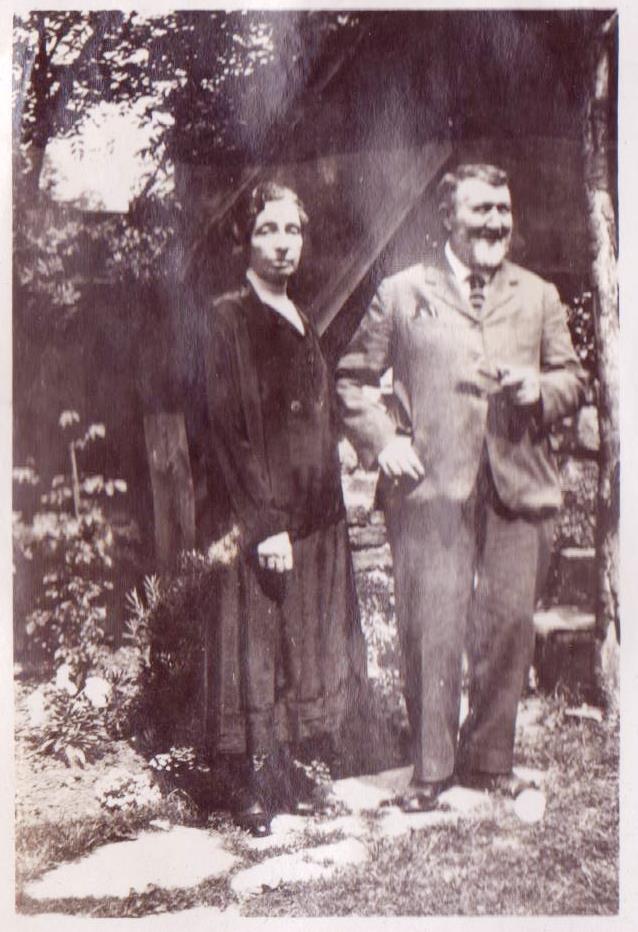
The family photo album contains the following photographs of WIlliam Fox Pinhey and Fanny Maude in England during the late 1920's. One can't help noticing that the Pinhey's appear happy to be back home.

                        William Fox Pinhey, Fanny Maude and the Stillwell Family
         Left to right: Eric William Stillwell ("Bill"), Clarence Stillwell, Fanny Sarah (Faff)                                        Stillwell, Fanny Maude Pinhey and William Fox Pinhey

Vacationing in Cornwall
Una Knevitt, William Fox Pinhey and Fanny Maude Pinhey

Vacationing in Cornwall

Back Home in England

 Fanny Maude Pinhey back Home in England

Fanny and William in Front of Their Home

William Fox Pinhey - Born September 2nd 1856. Died January 31st 1929.  Fanny Maude Pinhey - Born August 18 1860. Died August 5th 1936.

These are the last photographs of William Fox Pinhey and Fanny Maude Pinhey that I can find in the albums. If I find more, I will post them.

William Fox Pinhey in England, 1920's
This photo and the one below where in a 1920's photo grouping and added to this post on August 24, 2015.  The photo appears to have been taken the same day as the photo of William and Fanny with the Stillwell family. William is holding a pipe and wearing a pocket watch chain and fob that were common for the late Victorian and Edwardian periods. 

Fanny Maude Pinhey in England, 1920's